Planning a Forest-and-Casino Film Discussion Around One Scene
Plan a forest-and-casino film discussion with a clear scene, focused prompts and a simple way to connect the landscape to character and story.
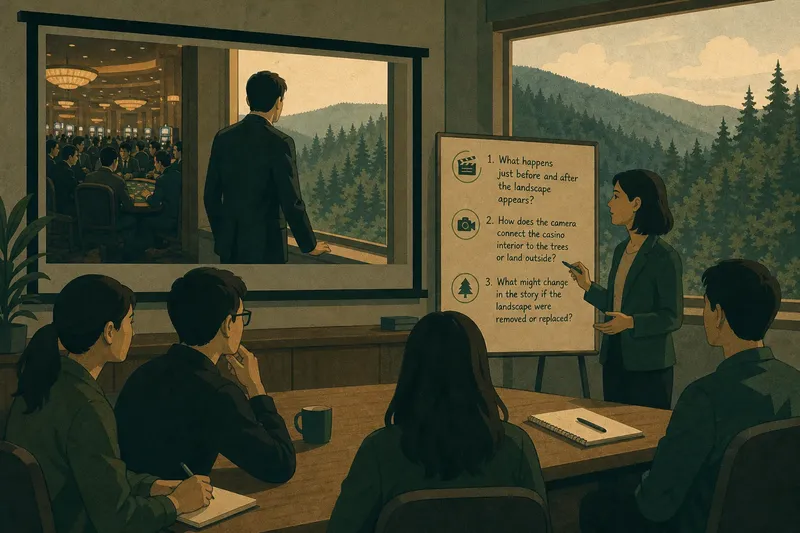
A forest-and-casino film discussion can begin with a guest stepping away from a crowded table while a wooded ridge fills the window. At Trường Đại học Lâm nghiệp, a seminar organiser might use that invented scene to ask how the landscape shapes one casino story, without treating it as a universal symbol.
Choose a scene where landscape affects the action
Select a clip with enough story context to show why the landscape appears. A tree-lined approach, a timber-framed entrance or woodland beyond a casino window can all work if the setting connects to a character’s action.
Check that the passage is suitable for the group and can be shown in the planned setting. If the landscape shot feels disconnected from the action, include more of the scene before and after it rather than relying on an isolated image.
Ask what this particular landscape contributes
Instead of asking what forests mean in general, ask what the ridge contributes to this moment. Does it make the casino seem remote, offer a visual pause from the room or simply establish the location?
A window works like a picture frame: it reveals part of the setting while leaving other details outside the shot. Viewers can discuss why the film includes the ridge, how long it appears and what the scene might lose if the view were absent.
Those questions keep interpretations tied to visible choices. They also allow different readings without turning one image into a rule about forests or casinos.
Give the discussion a simple viewing structure
Write three prompts on a board before the session:
- What happens just before and after the landscape appears?
- How does the camera connect the casino interior to the trees or land outside?
- What might change in the story if the landscape were removed or replaced?
On the first viewing, ask participants to follow the action. On a second viewing, invite them to notice the relationship between the building, the landscape and the character. A whiteboard or scrap paper is enough to record observations.
Use what is visible to guide the next question:
- If a character looks towards the trees, ask what that gesture changes in the moment; if not, treat the landscape as possible setting rather than assumed motivation.
- If the camera holds on the view, discuss why the film gives it attention; if the shot passes quickly, consider whether it mainly establishes place.
- If the frame shows both the casino and the ridge, compare their visual contrast; if it shows only one, avoid claiming the scene directly contrasts them.
- If the trees are clear enough to describe, use cautious everyday terms such as “conifers”; if details are indistinct, describe their colour, shape or density instead.
- If the clip gives enough context to follow the character’s choice, discuss how the view relates to it; if not, choose a longer passage that includes the relevant action.
- If viewers disagree about the ridge’s mood, ask which scene details support each reading; if none are clear, leave the impression tentative.
Connect the casino setting to a character’s choice
In the invented scene, a guest leaves a busy table, pauses at a window overlooking a wooded ridge and then returns to the room. One viewer might read the pause as a wish to withdraw; another might see a moment of hesitation before returning. Ask what visible details support each idea, such as the direction of the gaze or the timing of the turn.
Consider what would change if the window showed a city street, open water or a blank wall. If the ridge makes the venue seem secluded, that contrast may matter to the story. If the scene works much the same without the trees, the landscape may mainly establish the setting.
This approach keeps the discussion focused on narrative function, not broad claims about real casino destinations. A wooded road or distant hillside in a film does not establish where a real venue is located or how its surroundings are managed.
What questions help viewers discuss the scene?
How long should the clip be?
Choose a passage that includes the action leading into the landscape shot and what follows. If viewers cannot tell why the character pauses, include more context rather than replaying only the image.
Do participants need forestry knowledge?
No specialist knowledge is needed to discuss framing, mood or story. If tree species are unclear, describe visible shapes and colours rather than making a precise identification.
What if the forest is only in the background?
Ask whether it changes the mood, sense of place or character action. If it seems incidental, the group can say so without assigning it a symbolic role.
Can the group discuss casino architecture?
Yes, if the building helps explain how the landscape appears in the story, such as a window framing a ridge. If the conversation drifts into interiors alone, return to the connection between the space, the view and the character.
Work through a scene from the first viewing to the final reading
Say an organiser has a screen, a whiteboard and an invented clip showing a guest leave a busy table, pause at a window facing a wooded ridge, then return. The organiser plays it once and asks the group to describe only the action. The group records three observations: the guest leaves, looks outside and goes back.
The organiser replays the clip and asks what links the view to the action. Participants note that the guest faces the ridge and that the camera briefly includes both the window and the busy room. One viewer suggests the pause signals a wish to get away; another sees hesitation. The organiser writes each interpretation beside the detail that prompted it.
Finally, the group imagines replacing the ridge with a city skyline. If the sense of distance remains, they may decide that the venue’s separation matters more than the trees. If the mood changes because the wooded view feels quieter beside the crowded room, they may give the landscape a more active role. The result is a reasoned reading, not a claim about the film-maker’s intention.
Close on the detail that changed the reading
Ask each participant to name one detail that sharpened their interpretation: the character’s gaze, the camera holding the window in frame or the contrast between the quiet ridge and the busy room. Record the detail beside the reading it supports.
A forest-and-casino film discussion is most useful when viewers can explain how a particular setting serves a particular story. If the group wants to move on to real forest management or casino development, treat that as a separate subject and consult appropriate sources for factual claims.